Ten Proficiencies One Balanced Car
Aerodynamics, Structure and Kinematics are not independent to each other - they work together to define how a vehicle performs - change one and you have changed the others, whether you intended to or not.
GSD RaceDyn works across all of them, so you know the recommendation you receive accounts for the whole car not just one area.
Historic & Modern
FROM PRE-WAR TO GT3
Same Approach
MEASURE, ANALYSE, IMPROVE
Comprehensive Analysis
OUR RANGE OF CAPABILITIES ALLOW A FULL UNDERSTANDING OF THE CHASSIS
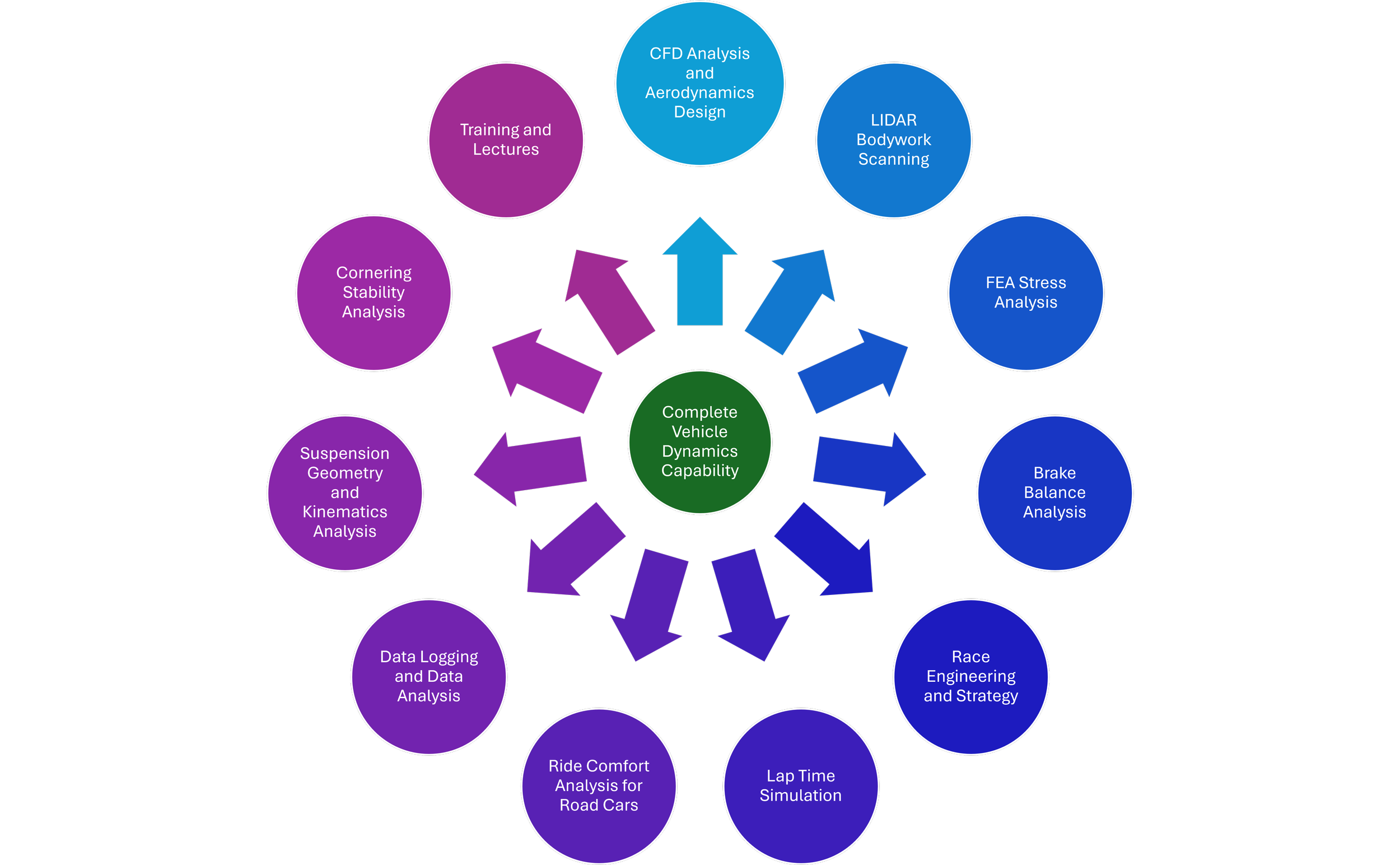
Capabilities
What we do, and what you get back.
Most of the vehicle dynamics work resolves into one deliverable: measure the car, analyse it, and hand back a report your engineers can work from. Everything else either feeds that report or is quoted alongside it.
The Vehicle Dynamics Report
The car is measured, modelled and analysed, and you receive a written report covering every axis of the setup — from what the car is doing now, through the suspension geometry, spring, damper and anti-roll bar specification, to a recommendations table the mechanics can build straight from. Old versus new is shown wherever a change is proposed, so nothing arrives as an unexplained number.
- Length
- 12–15 pages
- Covers
- Nine sections, front and rear
- Includes
- Full recommendations table, ready to build from
- Applies to
- Any car and any suspension type — historic, modern competition and road
Current-state summary
How the car handles in its current state, and what characteristics of the car are interacting to cost performance.
Recommendations table
Ride heights, spring rates, camber, castor, droop, toe, ARB dimensions, damper forces and settings with graphs, bump rubber configuration, packer gaps and target tyre pressures — every number in one place.
Geometry analysis
Suspension behaviour analysed throughout the relevant range of ride height, including camber change, deflection, roll centre height and migration, anti-geometry characteristics, kingpin inclination, scrub radius and roll camber compensation. Where changes are recommended, geometry is compared old against new to quantify the effect across the entire suspension system.
Spring, damper and ARB specification
Motion ratios, natural frequencies and wheel rates — calculated for both the current parts and the recommended specification, for quick comparison.
Braking analysis
Static and dynamic rake calculated using suspension anti-geometry to find nose and tail movement, giving a clearer view of dynamic platform movement through the braking process.
Cornering analysis
Mid-corner power-off conditions analysed across a range of speeds, with assessment of chassis and tyre roll at peak cornering G. Power-on corner exit conditions evaluated through each gear, with notes on power and torque application for neutral handling where the car has oversteer.
Aerodynamics
A description of the car's aerodynamic features, if any, stating quick improvements or issues along with their fixes, including lift and drag coefficients. Can include further detail from the aerodynamics department where they have been involved in the project.
Engine, transmission and tyres
Tyre sizes and target pressures, with tyre spring rate around the target pressure. Engine and gearbox details as supplied, with gear ratios, final drive and differential settings — ramp angles, friction surfaces and preload.
Wet setup
A separate full-wet configuration, so the car has a known starting point when the weather turns rather than a guess made in the assembly area.
Brake balance analysis
Pedal-to-pad analysis, with dynamic balance and thermal duty across a lap. Master cylinder and balance bar position specification, plus brake pad recommendations for optimal braking performance from theory.
Gear ratio simulation
Ratio selection against circuit, engine curve and limiter, with the time cost of each option quantified.
Steering weight analysis
Effort at the wheel through the corner, and where geometry or assistance changes it.
Steering ratio analysis
Rack ratio against required lock and driver workload, including quickening the rack without spoiling stability.
Bump steer analysis
Toe change through bump and roll, with the track rod position needed to correct it.
Multi-rate suspension systems
For cars with significant underbody downforce, where a single rate cannot serve both low-speed compliance and high-speed platform control.
CFD Analysis and Aerodynamics Design
Full-car external CFD to quantify downforce, drag and balance shift against ride height, rake and yaw. Concepts taken through to surfaces a fabricator can actually build.
- You receiveCL/CD maps vs ride height, rake and yaw
- Aero balance migration through the corner
- Pressure and flow-field plots with commentary
- Manufacturable surface data and part drawings
LIDAR Bodywork Scanning
Point-cloud capture of real bodywork, chassis and suspension hardpoints. Turns the car that exists into a model you can analyse — and shows where it has drifted from the homologation drawing.
- You receiveRegistered point cloud of body and chassis
- Watertight surface model for CFD and FEA
- As-built vs drawing deviation report
- Measured suspension hardpoint schedule
FEA Stress Analysis
Static, fatigue and buckling assessment of suspension, mounting and structural parts — under load cases taken from logged data rather than assumed multiples of vehicle weight.
- You receiveLoad cases from transmitted forces derived from real-world situations, specific to your part or component layout
- Stress, deflection and factor-of-safety results
- Report with part or assembly adjustments and material choice recommendations
- Component rate verification (ARB, uprights, links)
Lap Time Simulation
Quasi-static lap simulation with a four-corner tyre and weight-transfer model, correlated against your own logged data. Ranks setup and specification changes before the car leaves the workshop.
- You receiveBaseline correlation against logged laps
- Sensitivity studies: aero, mass, ratios, tyre
- Sector-level time deltas per change
- Speed, g and racing line traces
Data Logging and Data Analysis
Logger specification, maths channels and the analysis workflow around them. Sector, stint and degradation reporting built into tools your own engineers can run without us.
- We help withLogger and sensor specification
- Maths channel library and templates
- Sector, stint and tyre degradation reporting
- Bespoke MATLAB and Python analysis tools
Race Engineering and Strategy
Trackside engineering across endurance and sprint formats: run plans, fuel and tyre tracking, Code 60 and full-course-yellow response, and the paperwork that follows the result.
- You receiveRun plan, stint matrix and driver rotation
- Fuel and consumption modelling live in session
- Pit window and FCY / Code 60 contingency
- BoP and classification evidence submissions
Training and Lectures
The same analysis, taught rather than delivered, with the intricate details of the mechanics and their interactions explained in further depth. Structured sessions for engineers, mechanics and drivers that build the reasoning behind the numbers — so your team can read the car themselves between the times we are involved.
Race and data engineers moving up a category or just starting out, mechanics looking to understand what the setup sheet is asking for and why a change is being made, and drivers looking to improve their feedback so the engineer can act faster. Each session is tailored to the people attending rather than chosen from a set syllabus.
We are also available for university guest lectures, or to help guide module syllabus.
- Suspension kinematics and geometry fundamentals
- Tyre behaviour, load sensitivity and temperature
- Reading data: maths channels and comparison method
- Balance diagnosis from driver feedback
- Endurance strategy, fuel and stint planning
- Across one or two days
- In person or over Microsoft Teams
- Notes and worked examples supplied